April 28, 2026
Wabi-Sabi — Finding Beauty in Imperfection
Wabi-sabi, the Japanese aesthetic of imperfection and transience, offers a quieter path to meaning than the pursuit of an ideal life.
What wabi-sabi means
Wabi-sabi (侘寂) is one of those Japanese concepts that resists clean translation — not because it is mysterious, but because English has no single word for what it describes. Wabi originally referred to the loneliness of living in nature, away from society — a kind of austere simplicity. Sabi referred to the beauty that comes with age and wear: the patina on old metal, the crack in old ceramic, the moss on a stone wall.
Together they form an aesthetic sensibility that finds beauty precisely in what is imperfect, incomplete, and impermanent. A hand-thrown tea bowl with an uneven rim. A garden that looks slightly wild. A wooden floor worn smooth by decades of footsteps.
The concept is particularly central to Japanese craft traditions — ceramics, tea ceremony, garden design, ink painting — and to Zen aesthetics more broadly.
The connection to ikigai
Wabi-sabi and ikigai are not the same thing, but they share a common root: both push back against the idea that meaning requires perfection or grandeur.
The Western search for purpose often carries an implicit standard: your ikigai should be a calling, a passion, something that sounds impressive when you describe it at a dinner party. This is exactly the trap that Purpose vs. Passion unpacks. Wabi-sabi corrects this quietly. It suggests that the most durable sources of satisfaction are often modest, worn, and particular — not polished and universal.
A craftsman who has made furniture for forty years has a wabi-sabi relationship with his work. The bench he built is not perfect; it has a slight wobble he never quite corrected and a scar from a chisel that slipped. But those imperfections are part of it. They are the record of the making. His ikigai doesn't require the bench to be flawless.
The tyranny of optimization
Modern culture is heavily invested in optimization — the idea that there is always a better version of every situation, and that the goal is to get there. Applied to the search for purpose, this produces a particular kind of anxiety: the feeling that your current life is a draft, and that your real, optimal life is somewhere ahead, waiting to be found.
Wabi-sabi offers a different frame. The current life — imperfect, incomplete, marked by choices you'd revise — is not a draft. It is the thing itself. Meaning is not waiting in some future optimized state. It is available in the cracks and worn edges of the present one.
Kintsugi — the gold in the cracks
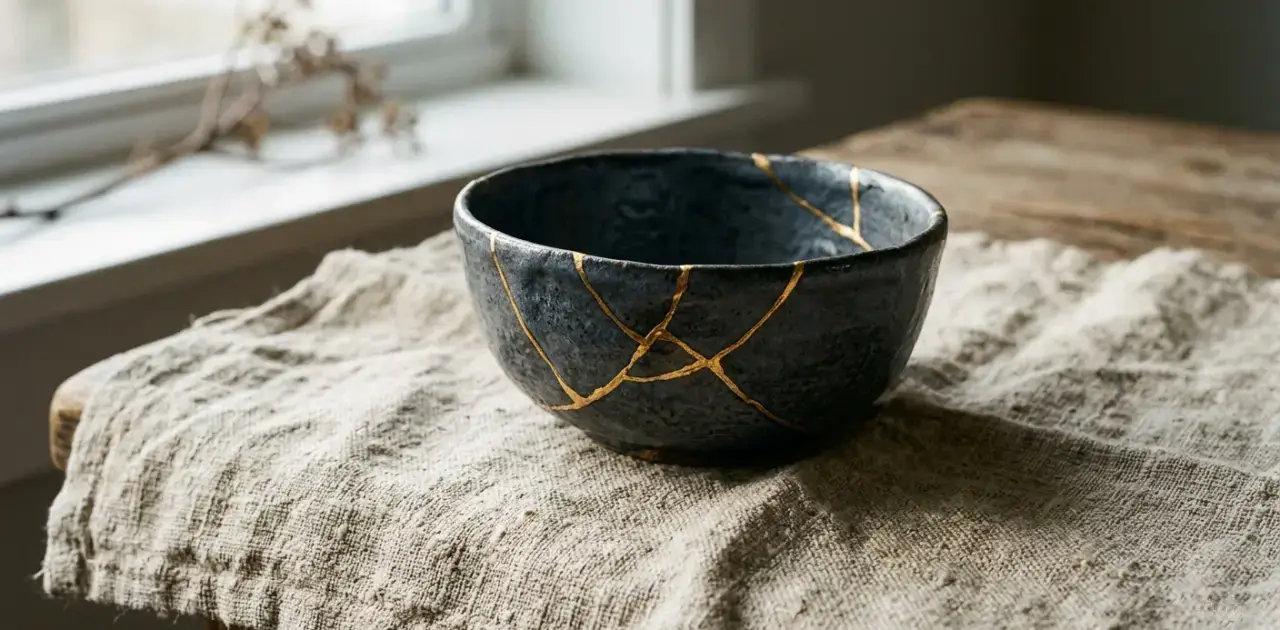
A related Japanese practice is kintsugi (金継ぎ): the art of repairing broken pottery with gold lacquer. Rather than hiding the repair, kintsugi makes it visible — the fracture lines become part of the object's beauty and history.
The philosophy behind kintsugi is that breakage and repair are part of the story of a thing, not flaws to be concealed. Applied to a life: the setbacks, the redirections, the plans that didn't work — these are not disqualifying. They are part of what makes the life legible, textured, real.
A practical invitation
The next time you feel stuck in the search for purpose — like you haven't found the right answer yet — try a wabi-sabi question instead: what is already here that has value, even in its imperfect form? The answer is usually closer than the optimized future you're searching for. A related perspective on impermanence: Mono no Aware, the Japanese sense of bittersweet beauty in what doesn't last.
Wabi-sabi in everyday decisions
The aesthetic becomes most useful when applied to concrete decisions, not just abstract philosophizing. A few places it shows up practically:
In creative work. The perfectionism that prevents finishing — or sharing — is often a failure to accept that the imperfect version has genuine value. Wabi-sabi doesn't mean settling for sloppiness; it means recognizing that the gap between what you made and what you imagined is part of the work's character, not a disqualifying flaw. The tea bowl with the uneven rim is not a failed perfect bowl. It is itself.
In career transitions. People who are changing fields often carry a residue of the old career — habits of mind, partial skills, ways of framing problems that don't quite fit the new context. Wabi-sabi suggests these aren't deficits to be hidden. They're often the most interesting thing about a career pivoten. The engineer who becomes a teacher brings something different from the career educator; the difference is the value, not a gap to be apologized for.
In relationships. Long relationships accumulate friction and imperfection — patterns that didn't get resolved, choices that can't be undone, the particular wear of years together. Wabi-sabi offers a frame for understanding those imperfections as part of the relationship's texture rather than evidence that it failed some ideal test.
The kintsugi lesson for career pivots
Kintsugi (金継ぎ) deserves more attention as a practical framework. The practice of filling cracks with gold lacquer rather than hiding the repair is not just aesthetically interesting — it encodes a specific claim about value: that the history of a thing, including its breakages, is part of what makes it worth attending to.
Applied to a career: the failed startup, the role that didn't work, the skills you developed in a direction that didn't pan out — these aren't subtractions from your value. They're part of the record. In many cases, the apparent failures are the most distinctive and interesting parts of a trajectory.
This is particularly relevant when interpreting ikigai test results. If your highest-scoring interest is one where your history is complicated — you tried it seriously and it didn't work, or you left it and came back — the wabi-sabi lens suggests that history might be an asset, not a liability. The kintsugi repair is visible; that's the point.
Wabi-sabi and the four circles
One place wabi-sabi pushes back against the four-circle model: the model implicitly optimizes for perfect overlap, and people often read their results as pointing toward a future perfect state where all four circles align. Wabi-sabi corrects this.
The current overlap — partial, imperfect, with gaps you can see clearly — is not a draft of the real thing. It is your actual ikigai as it currently exists, with the particular wear and grain of your specific history. You can work to improve the alignment. But the improvement will always be partial, and the imperfect version along the way is not lesser than the imagined perfect version ahead.
This reframe often makes the results feel more actionable: instead of "how do I get to the ideal state," the question becomes "what can I do from exactly where I am, with exactly what I have."
Frequently Asked Questions
Is wabi-sabi just an excuse to not try? No — and this is a common misreading. Wabi-sabi doesn't suggest that effort and improvement are pointless. The Japanese craft traditions that embody wabi-sabi are famous for extraordinary attention and skill. The point is that the standard of perfection is wrong, not that standards don't matter. A master potter cares deeply about the work; they just don't expect the work to be flawless or evaluate it by whether it matches an imagined ideal.
How is wabi-sabi different from "good enough"? "Good enough" is usually a concession — you've settled for less than you wanted. Wabi-sabi is an aesthetic position: the imperfect version has value in itself, not just as a compromise. The distinction matters because one leads to mild dissatisfaction and the other leads to genuine appreciation of what exists.
Where can I see wabi-sabi in practice? Japanese pottery, particularly raku ware and Bizen ware, is the clearest expression. The tea ceremony embodies it — the rough-hewn bowl, the asymmetrical room, the valued irregularity. In architecture, traditional Japanese interiors — exposed wood, natural materials, subdued color — express it structurally. In contemporary culture, it shows up in the appeal of handmade goods, patinated leather, linen that softens with washing.
Can wabi-sabi be applied to relationships with other people? Yes, and this may be where it's most needed. People — including ourselves — rarely match our idealized image of what they should be. Wabi-sabi offers a frame for appreciating what is actually present rather than evaluating people against a standard they can't meet. This doesn't mean accepting harm or dysfunction; it means releasing the expectation of perfection from the people and relationships that matter to us.
Take the Ikigai test as a structured way to look at what's already here — your current interests, skills, and values — rather than waiting for the perfect version to appear.